
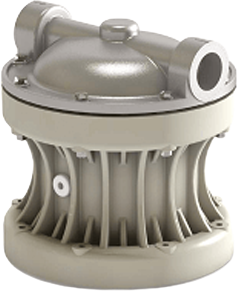
| Parameter | Value |
|---|---|
| Pulsation reduction | Up to 80% |
| Pressurisation medium | Compressed air or nitrogen |
| Types available | Inline and bladder type |
| Suitable for solids-containing fluids | Yes (inline type) |
| Available grades | Industrial and food/hygienic grade |
Inline vs Bladder Type
Inline dampeners are the more efficient option — longer in design, customisable in length, and capable of handling liquids with suspended solids. Flexible inline variants can also address pump vibration in addition to pulsation dampening, and carry a lower risk of damage from solids in the fluid.
Bladder type dampeners are more compact but may require a back pressure valve and manual pressure compensation. They are generally less efficient than inline types and can be susceptible to damage if solids enter the bladder.
Typical Applications
- Downstream of rotary gear, lobe, and vane pumps where smooth discharge flow is required
- Coating and precise container filling processes
- Flowmeter and instrumentation protection where pulsation causes measurement inaccuracy
- Spray system applications requiring a consistent, uniform flow pattern
Installation Notes
Install as close to the pump discharge outlet as possible. Ensure the selected dampener material is compatible with the process fluid — fluid properties, type, and viscosity must be confirmed prior to selection. Pulsation dampeners address flow pulsation and are not a substitute for anti-vibration mounts or flexible pump connections, which should be considered separately if mechanical pump vibration is also present.
Reviews
There are no reviews yet.